The FIFA World Cup is the biggest sporting spectacle on Earth. For decades, fans have been used to seeing 32 nations fight for the golden trophy. However, the next edition in 2026 is going to be fundamentally different. Hosted by the United States, Canada, and Mexico, World Cup 2026 marks the first significant structural overhaul in the competition’s modern history.
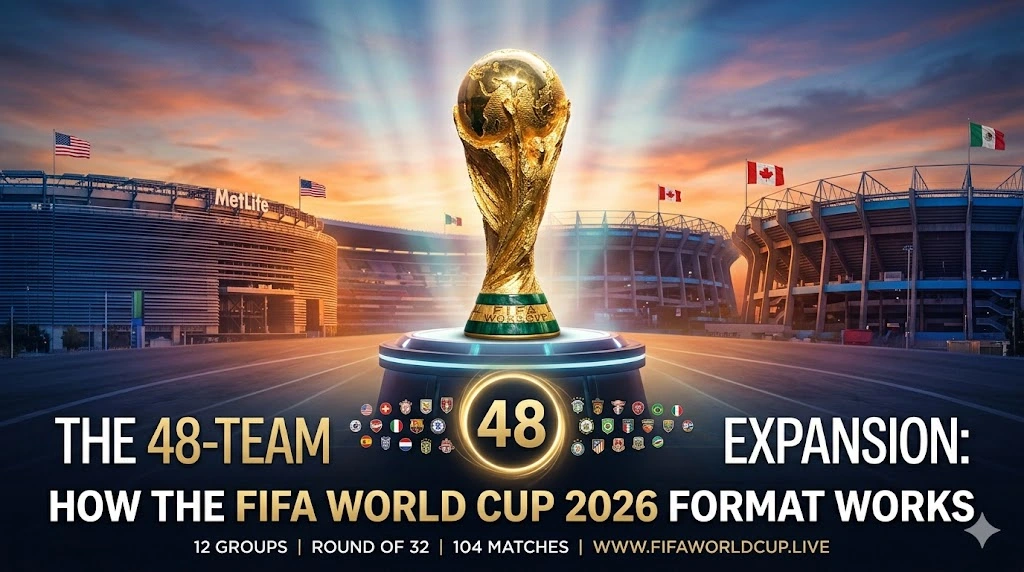
FIFA has officially expanded the tournament to feature 48 teams. This is a 50% increase from the previous format. For fans, this means more matches, more goals, more drama, and more emerging nations making their debut. But how exactly will this massive tournament work?
If you are confused about groups, knockout stages, or new rules, you are in the right place. This is your complete, easy-to-understand guide to the new FIFA World Cup 2026 format. Let’s break it down step-by-step.
Why the Expansion? The 32 vs. 48 Battle
Since 1998, the World Cup used a stable 32-team format. It had eight groups of four, and the top two teams from each group advanced to the Round of 16. It was simple, balanced, and fast-paced. So why change it?
FIFA’s primary motivation is global inclusion. By expanding to 48 teams, FIFA aims to give more nations from Africa, Asia, and North/Central America a realistic chance to qualify. This brings the joy of the World Cup to new corners of the globe. Financially, more matches also mean increased broadcasting and commercial revenue.
Table 1: Quick Comparison of Formats
| Feature | 2022 World Cup (Old) | 2026 World Cup (New) | Change |
| Total Teams | 32 | 48 | +16 Teams |
| Host Nations | 1 (Qatar) | 3 (USA, Canada, Mexico) | Expanded |
| Total Matches | 64 | 104 | +40 Matches |
| Tournament Duration | 29 Days | ~39 Days | Longer |
| Groups | 8 Groups of 4 | 12 Groups of 4 | +4 Groups |
| Knockout Entry | Round of 16 | Round of 32 | New Round |
| Max Matches by a Finalist | 7 | 8 | +1 Match |
Before diving into the format, check out our popular article: “5 Historic Records That Could Be Broken at FIFA World Cup 2026”.
Step 1: The New Group Stage Structure
This is where the biggest confusion lies. Initially, FIFA proposed 16 groups of 3 teams. However, fans and experts worried about collusion in the final group match. Thankfully, FIFA listened and settled on a more traditional, exciting structure.
In 2026, there will be 12 groups, labeled Group A through Group L. Each group will contain four teams.
Every team plays three matches in a round-robin format against their group opponents. This mirrors the familiar feeling of past World Cups. The group stage alone will feature 72 matches, providing non-stop action for more than two weeks.
Key Rule: The Third-Place Lifeline
In the old 32-team system, if you finished 3rd in your group, you went home. In 2026, finishing 3rd might not mean the end.
- The Top 2 teams from all 12 groups automatically qualify (24 teams).
- The remaining 8 slots in the knockout stage are filled by the eight best third-placed teams.
To determine the “best” third-placed teams, FIFA will create a single table ranking all twelve 3rd-place finishers based on:
- Total Points
- Goal Difference
- Goals Scored
- Fair Play Points (Disciplinary Record)
- Drawing of Lots (If still tied)
This new rule is a game-changer. It means every single goal in the group stage—even in the 90th minute of a losing match—could decide whether a team qualifies or goes home.
Want to travel to watch your country make history? Book your flights and hotels for the best deals across the three host nations!
Step 2: The Knockout Stage Revolution
With the 24 group winners/runners-up and the 8 best third-placed teams, we have a total of 32 teams remaining. This is where the single-elimination tournament begins.
The traditional Round of 16 is gone as the first knockout phase. In 2026, we introduce the Round of 32.
This adds an entirely new layer of pressure. Halving the field from 32 to 16 teams in one match will create incredible drama. From this point onward, the path is straightforward:
- Round of 32 (32 teams)
- Round of 16 (16 teams)
- Quarter-finals (8 teams)
- Semi-finals (4 teams)
- Third-Place Match (2 teams)
- The Final (2 teams)
Table 2: Step-by-Step Path to the Final
| Phase | Teams Involved | Matches | What Happens? |
| Group Stage | 48 Teams (12 Groups of 4) | 72 | Top 2 from each group + 8 best 3rd-place advance. |
| Round of 32 | 32 Teams | 16 | Single-elimination. Winners advance. |
| Round of 16 | 16 Teams | 8 | Single-elimination. Winners advance. |
| Quarter-finals | 8 Teams | 4 | Single-elimination. Winners advance. |
| Semi-finals | 4 Teams | 2 | Single-elimination. Winners advance to Final. |
| Final / 3rd Place | 4 Teams | 2 | Decide the winner, runner-up, and 3rd place. |
| TOTAL | 104 |
Gear up for the biggest World Cup ever! Get your official team jerseys and merchandise
The Player’s Burden: 8 Matches to Glory
One crucial consequence of adding the Round of 32 is that the road to the golden trophy is now longer.
Previously, a finalist played 7 matches (3 group, 4 knockout). In 2026, a team reaching the final four will have played 8 matches (3 group, 5 knockout).
While one extra match might seem small, it adds significant physical stress on players at the end of a long club season. Squad depth, rotation, and sports science will be more important than ever before. Teams cannot rely only on their starting eleven; they will need a deep, resilient roster to survive the 39-day marathon.
Conclusion
The FIFA World Cup 2026 is not just bigger; it is a fundamentally different tournament. The expansion to 48 teams, the 12 groups of 4, the introduction of the Round of 32, and the third-place lifeline all combine to create a historical shift in the sport’s landscape.
While critics argue the quality might be diluted, the benefits of greater global inclusion are undeniable. More nations will have a chance to dream, and fans will enjoy 104 matches of non-stop action across North America.
Stay tuned to fifaworldcup.live for more live updates, expert insights, and simplified guides as we approach the biggest football tournament in history!
Leave a Reply